
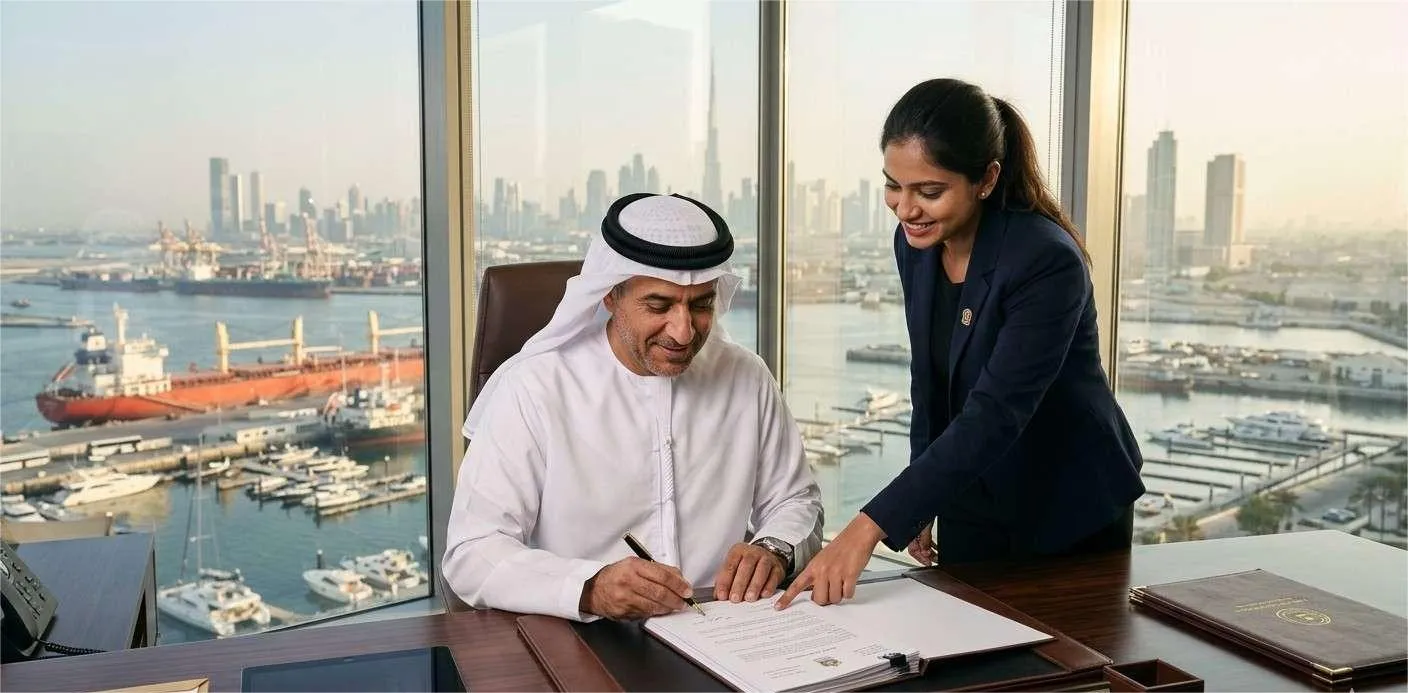
Discover how Offshore Company Formation Dubai works, who it’s for, key benefits, compliance requirements, and how Virtue Corporate Services simplifies the entire process.
Why Dubai Has Become the World’s Premier Offshore Jurisdiction
In a world where capital moves at the speed of a wire transfer and talent ignores borders, where you base your business entity matters more than ever.
Dubai has quietly, and then very loudly, emerged as one of the most strategically compelling jurisdictions for offshore company formation on the planet. Not because of marketing. Because of the substance.
A zero personal income tax regime. Political and economic stability that rivals Switzerland. World-class banking infrastructure. Bilateral investment treaties with over 100 countries. A time zone that bridges East and West within a single business day.
For entrepreneurs, investors, consultants, and holding company operators looking to restructure their international operations, Offshore Company Formation Dubai is no longer a niche strategy reserved for multinationals. It is a mainstream, compliance-friendly business tool that thousands of global founders are using today to protect assets, optimise taxes, and access markets they previously could not reach.
This guide explains how it works, who it is designed for, and how working with an experienced partner like Virtue Corporate Services can make the difference between a well-structured international entity and a costly administrative headache.
What Is an Offshore Company Formation in Dubai?
An offshore company in Dubai is a legal business entity registered in one of the UAE’s designated offshore jurisdictions — primarily the Jebel Ali Free Zone (JAFZA) and the Ras Al Khaimah International Corporate Centre (RAK ICC) — that is permitted to conduct international business but is not authorised to trade directly within the UAE domestic market.
This distinction is important. An offshore company is not the same as a free zone company or a mainland LLC. It is specifically structured for international operations: holding assets, owning intellectual property, managing investments, invoicing international clients, and structuring cross-border transactions.
Key characteristics of an offshore company formation in the UAE include:
- 100% foreign ownership — no local sponsor or partner required
- Zero corporate and income tax on offshore income
- Confidentiality — shareholder and director information is not part of a public register
- No requirement to rent physical office space — reducing operational overhead significantly
- Ability to hold international bank accounts and own real estate in designated UAE areas
- No minimum capital requirement in most offshore structures
It is a lean, compliant, and remarkably flexible vehicle when used correctly.
Who Should Consider Offshore Company Formation in Dubai?
Offshore structures are not a one-size-fits-all solution. They are, however, an excellent fit for a clearly defined set of business profiles.
International Consultants and Freelancers
High-earning professionals billing clients across multiple countries often carry disproportionate tax burdens in their home jurisdictions. A Dubai offshore entity allows them to invoice internationally through a zero-tax structure while maintaining full control over their income.
Holding Company Operators
Entrepreneurs who own multiple operating businesses — whether in Europe, Asia, or the Americas — frequently use a Dubai offshore company as the parent holding entity. This consolidates ownership, simplifies dividend flows, and can provide significant tax efficiency across the group structure.
Real Estate Investors
JAFZA and RAK ICC offshore companies are uniquely permitted to own freehold property within the UAE. For international investors acquiring Dubai real estate, this adds a layer of estate planning efficiency and eliminates certain inheritance complications that arise from direct personal ownership.
E-Commerce and Digital Business Owners
For businesses that operate entirely online and serve a global customer base, the physical location of the company’s incorporation has become genuinely flexible. A Dubai offshore entity provides a credible, zero-tax home for digital operations with access to international payment gateways and banking.
Family Offices and Wealth Managers
High-net-worth individuals use offshore structures in Dubai as part of broader wealth preservation strategies, holding portfolios of assets, managing succession planning, and insulating personal wealth from political or economic instability in their home countries.
The Offshore Company Formation Dubai Process: Step by Step
Understanding the setup process helps you plan accurately and avoid surprises. Here is a clear overview of what the journey looks like.
Step 1 — Jurisdiction Selection: Choose between JAFZA (Jebel Ali Free Zone Authority) and RAK ICC (Ras Al Khaimah International Corporate Centre). JAFZA is slightly more premium and better suited for companies that may want the option to own UAE property or require a prestigious Dubai address. RAK ICC is cost-effective, faster to set up, and widely used for international holding and trading structures.
Step 2 — Business Activity Declaration: You define the purpose of your offshore entity. Common activities include general trading, investment holding, consultancy, and intellectual property management. Activities must be declared accurately at the time of incorporation.
Step 3 — Shareholder and Director Documentation: Typical required documents include certified passport copies of all shareholders and directors, proof of residential address (utility bills or bank statements), a bank reference letter, and a brief CV or professional profile. Some jurisdictions may require additional due diligence documentation depending on the applicant’s nationality.
Step 4 — Memorandum and Articles of Association: Standard constitutional documents are drafted and filed with the relevant authority. These can be customised to reflect specific shareholder agreements, ownership structures, or governance preferences.
Step 5 — Certificate of Incorporation: Once all documents are verified and fees are paid, the certificate of incorporation is issued. This typically takes between 3 and 7 business days for RAK ICC and slightly longer for JAFZA.
Step 6 — Corporate Bank Account Opening: This is frequently the most strategically important step and also the most misunderstood. UAE banks have rigorous Know Your Customer (KYC) requirements. A well-prepared application — with a professional business plan, clear source of funds documentation, and evidence of legitimate commercial activity — significantly improves both approval rates and processing timelines.
Common Challenges and How to Navigate Them
Even well-intentioned applicants encounter friction in the offshore formation process. Here are the issues that come up most frequently, and how to approach them.
Banking Complexity: UAE banks exercise considerable discretion in onboarding offshore entities. The keys to success are transparency, documentation quality, and realistic expectations about timelines. Account approvals can take anywhere from four to twelve weeks. Working with a corporate services partner who has established relationships with UAE banking institutions can shorten this timeline considerably.
Misclassification of Business Activities: Declaring activities too broadly or selecting the wrong category can create compliance issues down the line. Each jurisdiction has a prescribed list of permitted activities. Accuracy at this stage protects you from complications during future account openings or corporate renewals.
Substance and Compliance Obligations: Following the UAE’s introduction of Economic Substance Regulations (ESR) and its adoption of OECD-aligned tax transparency standards, offshore companies engaging in certain regulated activities must demonstrate adequate economic substance. Staying current with these evolving requirements is not optional; it is a fundamental compliance responsibility.
Renewal Neglect: Offshore licences require annual renewal. Lapses result in penalties and, in some cases, the need to re-register the entity entirely. Calendar management and proactive renewal are simple but frequently overlooked.
What Changed and What It Means for You
The UAE has undergone a significant regulatory transformation since 2019. The country has been proactive in aligning with global anti-money laundering standards, FATF recommendations, and OECD Common Reporting Standards (CRS).
This means offshore structures in Dubai are now robustly regulated, a fact that has actually increased their credibility with international banks and institutional counterparties who previously viewed offshore jurisdictions with scepticism.
Key compliance obligations for offshore companies in the UAE today include:
- Ultimate Beneficial Owner (UBO) Registration — mandatory disclosure of all natural persons with a controlling ownership interest
- Anti-Money Laundering (AML) compliance — adherence to Federal AML laws applicable to all UAE-registered entities
- Economic Substance Regulations — applicable to entities conducting relevant activities, including holding company activity, intellectual property activity, and finance and leasing
- Annual licence renewal — managed through the relevant offshore authority
Far from being a loophole jurisdiction, Dubai is now one of the world’s most transparent and compliance-forward offshore destinations. That credibility is part of what makes it attractive.
Why Virtue Corporate Services?
Navigating the offshore formation landscape requires more than a checklist. It requires an advisor who understands both the regulatory framework and the commercial realities of structuring an international business correctly from day one.
Virtue Corporate Services provides comprehensive support for entrepreneurs and investors pursuing Offshore Company Formation in Dubai and across the UAE, from jurisdiction selection and documentation through to bank account facilitation, ongoing compliance management, and annual licence renewals. Their team brings practical, sector-specific experience across holding structures, real estate investment vehicles, and international trading entities.
For global founders who want a clean, well-structured offshore entity without the administrative friction of navigating it alone, Virtue Corporate Services offers a genuinely experienced partner in that process.
Frequently Asked Questions
Q1: Is an offshore company in Dubai legal? Absolutely. Offshore companies registered in JAFZA or RAK ICC are fully legal entities incorporated under UAE law. They are compliant with international regulatory standards, including FATF, CRS, and OECD guidelines, when properly maintained.
Q2: Can an offshore company open a UAE bank account? Yes. Offshore companies can open corporate bank accounts with UAE-based banks, though the approval process requires thorough documentation and varies by institution. Having a credible business profile and professional support significantly improves outcomes.
Q3: Can I use a Dubai offshore company to own UAE property? Yes, JAFZA and RAK ICC offshore entities are permitted to own freehold property within designated UAE areas. This makes them a popular vehicle for real estate investment and estate planning purposes.
Q4: How long does Offshore Company Formation in UAE take? RAK ICC incorporations typically complete within 3 to 7 business days once documents are in order. JAFZA may take slightly longer. The overall operational timeline, including banking, is more commonly 6 to 10 weeks.
Q5: What is the difference between an offshore company and a free zone company in Dubai? A free zone company can operate within the UAE market, maintain a physical office, and employ staff locally. An offshore company is designed for international business only, cannot trade within the UAE domestic market, and has no office requirements. Offshore structures are typically leaner and lower cost, but more limited in their permitted activities.
Build Smarter, Structure Intentionally
Offshore Company Formation UAE is not about secrecy. It is not about avoidance. It is about building a business infrastructure that reflects how modern commerce actually works, borderless, efficient, and compliant.
For entrepreneurs and investors who understand the value of getting the structure right before the business scales, Dubai offers one of the most credible and commercially sensible offshore jurisdictions available today.
The decisions you make at the point of incorporation will follow your business for years. Taking the time to understand your options and working with the right partners to execute them is not overhead. It is a strategy.